Trying to work out how many calories you should eat can be confusing. One calculator gives you one number, an app gives you another, and a website suggests something completely different. So, which one are you actually supposed to follow?
If you’ve been searching for calorie deficit South Africa articles, you probably want to understand why these numbers differ and which one is right for you. This guide explains how calorie deficits work, how to calculate a realistic daily target, and how to adjust it based on your body, lifestyle, activity levels, and weight-loss goals.
Key Takeaways
- Your calorie needs are individual: Your age, height, weight, muscle mass, and daily activity all influence how much energy your body uses. Someone else’s calorie target isn’t necessarily right for you.
- A larger calorie deficit isn’t always better: Cutting too many calories can leave you hungry, tired, and struggling to concentrate. Choose a realistic target that allows you to enjoy satisfying meals and manage your everyday responsibilities.
- You don’t have to give up your favourite foods: Pap, pasta, chocolate and other familiar foods can still fit into a calorie deficit. Paying attention to portions and including protein and fibre in your meals can help you manage hunger without making eating feel restrictive.
- You don’t need to count every calorie: Tracking can help you recognise portion sizes and understand your eating habits, but it’s not essential for everyone. The Daily Calorie Target Planner can help you estimate your needs and make adjustments as your goals and activity levels change.
What is a calorie deficit?
 A calorie deficit means eating fewer calories than your body uses for energy (essentially how to lose weight). This relationship between the energy you get through food and the energy your body uses is known as your daily energy balance. When you’re not getting enough energy through food, your body uses its stored energy to make up the difference.
When eating less doesn’t always mean you’re in a calorie deficit
Skipping breakfast or having a small lunch doesn’t automatically mean you’re eating fewer calories than your body needs. You might have a salad for lunch, but then order takeaway for dinner, have a sugary coffee in the afternoon and snack while watching TV. You could easily end up eating more than you realise.
Research has found that people often underestimate how much they eat [psychologytoday.com]. It’s so easy to forget about the little things. A spoonful of mayonnaise in a sandwich, cooking oil in a pan, a handful of chips while making dinner, or a second helping at a braai might not seem like much on its own. However, these extras all contribute to your daily calorie intake.
Calorie deficits don’t have to feel restrictive
A calorie deficit doesn’t mean giving up everything you enjoy eating. You can still have pap with your Sunday lunch, enjoy pasta for dinner or have something sweet after a meal. You don’t need to replace every familiar food with a low-calorie alternative just because you’re trying to lose weight.
Consider how difficult it would be to follow an eating plan that means turning down every family braai, birthday cake or meal out with friends. Food is part of socialising, celebrating and spending time with people you care about. Feeling like you have to avoid these occasions to stay on track can make weight loss feel like a punishment.
Rather than banning certain foods, pay attention to portions and how your meals fit together. Having a slice of cake at a birthday party doesn’t mean you’ve ruined your efforts, and there’s no reason to give up on your plans because you enjoyed something you like.
How do you calculate your calorie deficit?
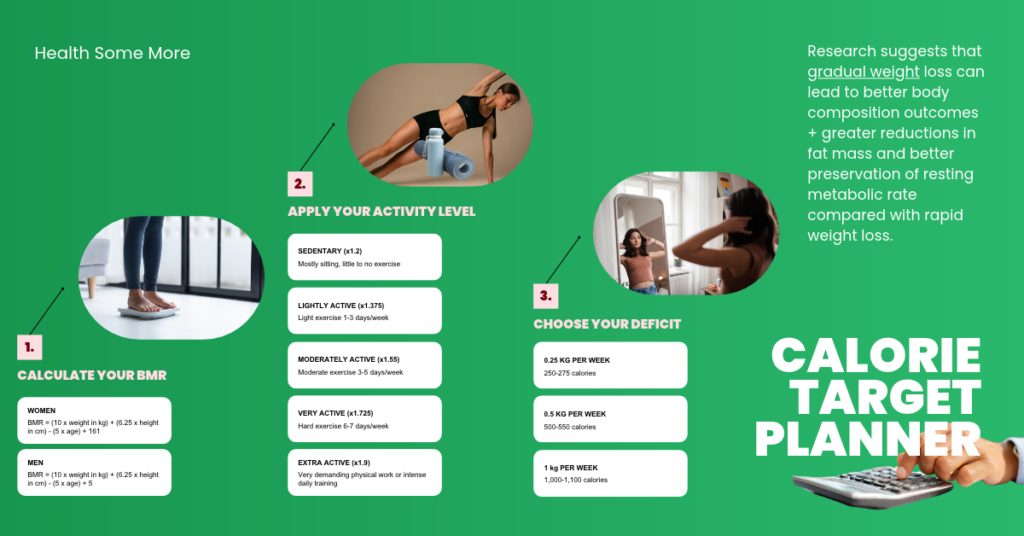
To calculate a calorie deficit, you first need to know roughly how many calories your body uses each day to maintain your current weight. This is known as your Total Daily Energy Expenditure (TDEE). A TDEE calculator South Africa can help estimate this based on your personal details and activity level. Once you have this number, subtract your intended calorie deficit to get your daily target. For example, someone whose estimated maintenance requirement is 2,200 calories could aim for 1,900 calories a day to create a 300-calorie deficit.
Your calorie target isn’t the same as someone else’s
Your calorie needs are personal because they depend on factors such as your age, sex, height, weight, muscle mass, and activity level. Someone who spends most of their day sitting at a desk and rarely exercises will generally need fewer calories than someone who is constantly moving around.
Daily movement also counts, not just time spent exercising. Think about someone who works from home, spends most of the day at a computer and drives everywhere, compared with someone who walks to work, spends hours on their feet and rarely sits still during the day. Even when these two people have similar body measurements, their daily energy requirements can be quite different.
This is why copying someone else’s calorie target will not necessarily give you the same results. A friend might tell you that they lost weight eating 1,600 calories a day, but that doesn’t mean 1,600 calories is the right target for your body. Their height, weight, activity levels and energy requirements may be completely different to yours.
How to choose a calorie target you can actually maintain
Eating fewer calories does not necessarily mean you will lose weight faster. For some people, aiming to lose around 0.25 kg or 0.5 kg a week may be easier to manage, while trying to lose 1 kg per week can require a much larger deficit.
Consider what that difference could look like during an ordinary week. A larger deficit can leave you with less room for satisfying meals, snacks and the occasional takeaway. You might find yourself going to bed hungry, struggling with afternoon cravings or thinking about your next meal while trying to concentrate at work. These experiences can make a calorie target difficult to maintain, even when the number looks achievable on paper.
A moderate calorie target is usually easier to stick to. Choosing a realistic goal for your routine makes it easier to stay on track without constantly feeling the need to eat less. You should also consider whether your target leaves enough room to eat balanced meals and get the energy you need for work, exercise and everyday activities. A calorie target that requires you to ignore persistent hunger or push through constant exhaustion is worth reconsidering.
Daily Calorie Target Planner
How many calories do you need to lose 1 kg?
If you’re wondering how many calories to lose 1 kg, a total deficit of around 7,700 calories is often used as a rough estimate for losing 1 kg of body fat. For example, a daily deficit of 500 calories adds up to 3,500 calories per week. However, this doesn’t mean you can predict exactly when you’ll lose a kilogram by following this calculation. Your energy requirements change as your body weight changes, and actual weight loss doesn’t follow a perfectly straight line.
Trying to lose weight too quickly usually backfires
A very large calorie deficit can leave you feeling hungry, tired, and unable to concentrate during the day. You may also experience increased cravings for certain foods, making it harder to stick to your goals. You might start thinking about food more frequently, struggle to get through the afternoon without reaching for something to eat, or find yourself looking forward to your next meal more than usual. Even ordinary activities, such as exercising after work or preparing dinner, can feel more difficult when you’re not eating enough to support your energy needs.
There is also a difference between following a calorie target for a few days and being able to maintain it as part of your normal routine. Someone might manage a very restrictive eating plan during the working week but find themselves extremely hungry by Friday evening. This can make it harder to maintain the same eating pattern, particularly when social occasions, family meals and everyday responsibilities are involved.
Rather than responding to slow progress by cutting even more calories, look at whether your current target is realistic. A calorie deficit should not leave you constantly exhausted or struggling to concentrate. A slower, more manageable approach can make it easier to maintain your eating habits without feeling like you’re constantly fighting hunger.
Your weekly progress matters more than daily weight changes
Your weight can move up and down from one day to the next, even when you are following your calorie target. Water retention, hormonal changes, how much salt you eat, and even when you last had a bowel movement can all affect what you see on the scale.
For example, you might weigh yourself on Monday morning and find that you’ve gained 0.5 kg since Friday. It’s easy to assume that your efforts over the weekend haven’t worked, particularly when you’ve been paying attention to your portions and making an effort to stay within your calorie target. However, a higher reading doesn’t automatically mean you’ve gained body fat. A saltier meal, changes in carbohydrate intake, or water retention around your menstrual cycle can all influence the number on the scale.
A 2023 study published in the American Journal of Human Biology followed 42 women throughout their menstrual cycles. Researchers recorded an average weight increase of approximately 0.45 kg during menstruation, which was largely associated with increased extracellular water rather than a change in body fat [fitchef.com].
One higher weigh-in doesn’t always mean you’ve gained body fat. Instead of worrying about one higher number, look at your weight across the week to get a better idea of how you’re progressing. Weighing yourself under similar conditions, such as in the morning after using the bathroom and before breakfast, can also make comparisons more consistent.
What foods help you stay in a calorie deficit without feeling hungry?
Choosing foods that keep you satisfied makes a difference when you’re trying to manage your calorie intake. Protein-rich foods, vegetables, fruit, beans and whole grains can help you build meals that provide enough food without using up your entire calorie allowance. You don’t need expensive diet products or complicated recipes either. Everyday foods such as eggs, chicken, lentils, oats and plain Greek yoghurt can all have a place in your meals.
Why protein keeps you fuller for longer
Protein does more than help maintain muscle. It also plays a role in appetite regulation, which can be useful when you’re trying to lose weight without feeling hungry between meals. Research published in Physiology & Behavior in 2020 analysed 49 studies examining the short-term effects of protein consumption. Researchers found that protein intake reduced reported hunger and increased feelings of fullness after eating. The long-term findings were less conclusive, but the results help explain why including protein in meals can be useful when managing your appetite [pubmed.ncbi.nlm.nih.gov].
You don’t have to rely on protein shakes or supplements to get enough protein in your meals. Eggs at breakfast, chicken breast in a sandwich, tuna with a salad or lean mince with vegetables are all practical options. Plain Greek yoghurt and beans are also useful choices, particularly when you want something that doesn’t require much preparation.
Think about the difference between having two slices of toast with jam for breakfast and having two eggs on whole-wheat toast. Both can fit into a balanced eating pattern, but the eggs provide protein that can help you feel more satisfied after eating. When breakfast doesn’t keep you full, you might find yourself looking for something else to eat well before lunchtime.
Build meals that keep you satisfied for hours
A filling meal doesn’t need to be complicated. Try including a source of protein, vegetables, a fibre-rich carbohydrate and some healthy fat. Each contributes something different to the meal, so you’re not relying on one ingredient to keep you satisfied.
For example, a South African-style lunch could include grilled chicken, brown rice, salad and avocado. At dinner, you could have lean mince with mixed vegetables and sweet potato, or grilled fish with roasted vegetables and a portion of pap. You don’t have to remove carbohydrates to manage your calorie intake. The amount you serve and what you eat alongside them are worth paying attention to as well.
Fibre is another consideration when planning meals. Foods such as beans, lentils, oats, vegetables and whole grains add bulk to meals, and certain types of fibre can help with feelings of fullness. A systematic review published in Obesity Reviews found that the effects varied depending on the type of fibre, with more viscous fibres showing greater potential to reduce appetite than some other types.
At breakfast, unsweetened almond milk can also be a useful alternative to regular milk in oats or smoothies, particularly when you’re looking to reduce the calorie content of a drink or meal. However, check the nutritional label before making the swap. Almond milk generally contains less protein than cow’s milk, so it shouldn’t be treated as a replacement for a protein source.
Why cutting out every sweet treat usually doesn’t work
Completely avoiding chocolate, biscuits or your favourite dessert can make eating feel unnecessarily restrictive. You might manage without them for a few days, but that doesn’t mean you’ll enjoy following those rules or find them easy to maintain. Food is also part of birthdays, family gatherings and evenings spent with friends, so trying to avoid every occasion involving something sweet can become frustrating.
Imagine getting home after a long day and wanting a piece of chocolate with your cup of tea. Rather than telling yourself you can’t have it because you’re trying to lose weight, consider how it fits into what you’ve eaten that day. A small portion of something you enjoy doesn’t automatically put you outside your calorie target.
You can also make small adjustments to the way you prepare your favourite foods. Raw honey, for example, can add sweetness to plain Greek yoghurt, porridge or homemade smoothies. It is still a source of calories, though, so it needs to be included in your daily intake just like regular sugar. Choosing honey doesn’t automatically make a meal lower in calories, but it can be an option when you prefer its taste.
Do you have to count calories to lose weight?
No, you can lose weight without counting every calorie. While a calorie deficit is necessary, simple changes like choosing filling foods, managing portion sizes, and being more aware of what you eat can help lower your calorie intake without tracking every meal. Some people find it helpful to record their food for a while, while others prefer to make changes to their usual eating habits without measuring or logging everything. Both approaches can work.
When calorie tracking helps (and when it becomes overwhelming)
Using a calorie tracker can be useful when you are starting because it shows you how many calories are in the foods and portions you eat. When exploring calorie tracking SA tools, look for an app that allows you to record meals, save frequently eaten foods, and check portion sizes. This can also help you understand where most of your daily calories are coming from.
For example, you might be surprised by how different the calorie content of two seemingly similar meals can be. A homemade chicken sandwich and a takeaway chicken burger might look like comparable lunch options, but the sauces, cooking methods, cheese and portion sizes can make a noticeable difference. Logging what you eat can help you identify these differences rather than relying on guesswork.
Research published in Public Health Nutrition in 2021 reviewed 59 weight-loss intervention studies that used dietary self-monitoring. The researchers found that both more detailed tracking and less intensive approaches, such as recording selected aspects of food intake, could support weight loss [pmc.ncbi.nlm.nih.gov]. This suggests that keeping a record doesn’t necessarily mean weighing and logging every ingredient you eat.
However, tracking isn’t enjoyable (or helpful) for everyone. Having to enter every snack, check restaurant portions, or work out the calories in a homemade meal can become exhausting. Some people also find themselves feeling guilty when they go over their daily target or worrying about whether they’ve logged something accurately enough. When keeping track starts taking the enjoyment out of eating or making you anxious about food, it’s worth stepping back. You can still work towards a calorie deficit without recording every meal.
Conclusion: Find a Calorie Target That Works for You
Successful weight loss isn’t about eating as little as possible or following the same calorie target as someone else. Your energy needs, daily routine, and relationship with food all play a part in finding an approach you can actually maintain. Some days you’ll be more active, some meals will be bigger than others, and your routine won’t always look the same. Your calorie target should be a useful guide, not another reason to feel guilty about what you’ve eaten.
Use the Daily Calorie Target Planner to help estimate a target that reflects your goals and activity level. You can revisit it when your circumstances change, but don’t feel pressured to keep lowering your calories whenever the scale doesn’t move as quickly as you’d hoped. Understanding your needs and making informed adjustments is much more useful than constantly trying to eat less.
FAQs about Being in a Calorie Deficit South Africa
How do you work out your calorie deficit in South Africa?
To work out your calorie deficit, first estimate how many calories you need to maintain your current weight, also known as your Total Daily Energy Expenditure (TDEE). You can use a TDEE calculator to estimate this using your age, height, weight, sex and activity level. For example, someone whose maintenance requirement is approximately 2,200 calories could aim for 1,900 calories a day to create a 300-calorie deficit.
How do you lose 5 kg in 7 days?
Losing 5 kg in 7 days is neither realistic nor safe for most people. Although the number on the scale might drop quickly when someone drastically reduces their food intake, this doesn’t mean they’ve lost 5 kg of body fat. Changes in water retention, glycogen stores and the amount of food in the digestive system can all contribute to short-term weight changes.
Trying to force such rapid weight loss through extreme calorie restriction, dehydration or excessive exercise can also leave you feeling weak, dizzy and exhausted. Rather than chasing a particular number within seven days, focus on an eating pattern that provides enough energy and supports gradual, sustainable weight management.
What snack is filling but not fattening?
No food is automatically fattening, and you don’t need to avoid certain snacks to lose weight. What you eat, how much you have, and how it fits into your overall calorie intake all matter. For something that keeps you satisfied between meals, try plain Greek yoghurt with berries, a boiled egg with whole-wheat toast, apple slices with a small portion of peanut butter or hummus with carrot and cucumber sticks. These options provide a combination of protein, fibre or healthy fats, which can help make a snack more satisfying than something that offers very little nutritional value.