You finish work, look at the clock, and realize there’s no way you’re driving to the gym. The kids still need attention, supper still has to be made, or you’re closing your laptop after working from home and already feeling drained. When life gets busy, exercise is often the first thing to fall away. If you’re looking for no equipment workouts South Africa offers for busy adults, you don’t need expensive equipment or hour-long gym sessions to build a fitness routine that fits into your day.
Key Takeaways
- A workout you can stick to every week is better than a long workout you rarely have time for.
- You don’t need a gym or expensive equipment to build strength and improve your fitness.
- Matching exercises to your current fitness level makes it easier to stay consistent and reduces the risk of injury.
Do no-equipment workouts actually work?
Yes. No-equipment workouts can improve your strength, fitness, and overall health when done consistently. Bodyweight exercises use your own body weight as resistance to challenge your muscles while also improving balance, mobility, and cardiovascular fitness. You don’t need a gym or expensive equipment to see progress.
Why consistency beats the “perfect” workout
Planning one long gym workout every Saturday sounds like a good idea, but one busy weekend or unexpected change of plans is enough to miss it. That leaves you without any exercise for the week. Shorter workouts spread across the week are easier to keep because missing one session doesn’t mean you’ve missed all your exercise.
A short workout is still a workout. Doing 10 minutes of exercise four or five times a week is easier to maintain than trying to fit in one long session you keep putting off. The “perfect” workout is the one you can realistically make time for and complete.
When bodyweight exercises stop being challenging
It’s normal for bodyweight exercises to start feeling easier after a few weeks. That’s actually a good sign because it means your body is adapting to the movements. When the exercises start feeling easier than they used to, your body is ready for something a little more challenging.
You don’t need to buy weights to continue progressing in your workouts. A few changes can make those same exercises feel challenging again. For example, try slowing down each repetition, adding a few more repetitions, taking shorter rest breaks, or attempting a more challenging version of the exercise. You can add resistance bands or light weights in the future for an extra challenge to further improve your progress. A pair of 4kg dumbbells can add extra challenge to movements like squats, lunges, shoulder presses, and arm exercises, helping you build strength as your fitness improves.
What is the best full body home workout without equipment?
The best full body home workout without equipment includes bodyweight exercises that work your upper body, lower body, core, and heart. Combining movements like squats, push-ups, lunges, planks, and burpees into one workout helps you build strength and improve your overall fitness in a single session.
Try this full body bodyweight circuit:
- Push-ups – A great upper-body exercise that strengthens your chest, shoulders, and arms while engaging your core. If a standard push-up feels too difficult, start on your knees or use a kitchen counter for an incline version until you build more strength.
- Bodyweight squats – Squats strengthen your legs and glutes, improving movements like sitting, standing, and climbing stairs. Keep your weight on your heels and lower yourself as if sitting back into a chair.
- Reverse lunges – Reverse lunges strengthen your legs one side at a time, helping improve balance and stability while making everyday movements feel easier.
- Plank – The plank strengthens your core, supports your lower back, and improves stability in daily activities. Aim to keep your body in a straight line rather than just holding the position longer.
- Burpees – Burpees combine strength and cardio, giving your whole body a workout while raising your heart rate. If the full movement feels too challenging, skip the jump and go at a comfortable pace.
Complete each exercise for 40 seconds, then rest for 20 seconds before moving to the next one. Once you’ve finished all five exercises, rest for 60 seconds and repeat the circuit three times.
Want more routines to choose from? Try these 30-minute home workouts for more ways to exercise without making a trip to the gym.
Why doing the same workout every day can slow your progress
Doing the same workout every day might seem like the quickest way to get fitter, but your body gradually gets used to repeating the same movements. Once that happens, the workout no longer feels as challenging as it did at the beginning, which means you’re not getting the same benefit.
You don’t need a completely different workout every day. Changing a few exercises every week or two, mixing up the order of your routine, or trying a different variation is usually all it takes. It keeps your workouts from feeling repetitive and gives your body a new challenge without making things more complicated.
How do you build a workout that matches your fitness level?
The easiest way to choose the right exercises is to start with movements you can perform with good technique from the first to the last repetition. If you can’t do an exercise with good form, start with a simpler version and build up from there. For example, beginners may find chair squats, wall push-ups, and modified planks more manageable, while someone already comfortable with those movements can progress to bodyweight squats, standard push-ups, jump squats, or more advanced plank variations.
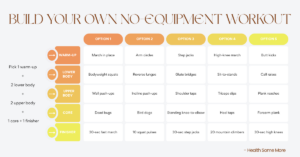
Choosing exercises that suit your current ability helps you exercise with better technique, lowers the risk of injury, and makes each workout feel achievable. As those exercises become easier, you can gradually move on to more challenging variations. The Home Workout Builder Cards below make it easier to choose exercises that match your fitness level without having to guess where to start.
Home Workout Builder Cards
Getting started is often the hardest part. Not because the workout is difficult, but because you’re unsure which exercises to do. After scrolling through videos, comparing routines, or wondering where to start, it’s easy to lose motivation before you’ve even begun.
Which bodyweight exercises SA are best for beginners?
The best bodyweight exercises for beginners are bodyweight squats, wall push-ups or knee push-ups, glute bridges, reverse lunges, planks, and dead bugs. They help you build strength in your body while enhancing balance, coordination, and stability.
- Bodyweight squats – The controlled movement and ability to adjust the depth make squats easier for beginners while helping build leg strength.
- Wall push-ups or knee push-ups – Starting against a wall or with your knees supported makes the movement easier while helping you gradually build upper-body strength.
- Glute bridges – Because the exercise is performed lying down, it places less stress on your joints while helping you build strength in your glutes and core.
- Reverse lunges – Reverse lunges are easier for beginners than forward lunges because stepping backward can help you stay more balanced and controlled.
- Planks – Planks can be modified by holding them for shorter periods or performing them from your knees, making them easier while building core stability.
- Dead bugs – The exercise uses slow, controlled movements that help build core strength, balance, and coordination while keeping the movement easy to manage.
Exercises beginners often avoid (but shouldn’t)
Exercises such as push-ups and squats can be difficult, especially when attempting the full versions. Easier variations help you build strength gradually, refine your technique, and gain confidence as you progress.
- Incline push-ups – Doing push-ups against a kitchen counter helps reduce the body weight you push, making it easier to practice and build upper-body strength.
- Assisted squats – Using a chair for support helps you learn proper squat technique while building leg strength.
- Wall sits – Holding a seated position against a wall strengthens your legs without requiring repeated up-and-down movements, making it easier to manage while building endurance.
- Glute bridges – This exercise strengthens the hips and glutes while reducing lower back pressure, helping beginners build a strong foundation.
Is muscle soreness a sign of a good workout?
Muscle soreness is often mistaken for a sign of a good workout. Feeling sore after exercising doesn’t necessarily mean you’ve trained harder or made more progress. Soreness can occur after trying a new exercise or increasing the intensity of your workout, but it’s not the best way to judge how effective it was.
Real progress is easier to see in the way your body performs. If you’re exercising regularly, completing more repetitions, holding a plank for longer, or moving from wall push-ups to knee push-ups, you’re becoming stronger. Those gradual improvements, together with staying consistent, are far better signs of progress than muscle soreness.
What you eat around your workouts matters too, especially if you’re trying to manage your weight. See which protein shakes for weight loss can help you add more protein to your day.
How do you stay motivated to exercise at home?
Staying motivated to exercise at home is easier when you remove the small obstacles that make it easy to skip a workout. Having a regular workout time, planning your routine before you start, and keeping everything you need nearby makes it much easier to stay consistent, even on busy days.
Having comfortable workout clothing ready can also make starting a workout feel easier. A pair of full-length leggings and a longer-length tank top can provide a comfortable option for movements like squats, lunges, stretches, and bodyweight exercises.
Your workout space matters more than motivation
Small changes to your workout space can make it easier to start exercising by removing the steps that often lead to procrastination. Laying out your workout clothes the night before means you don’t have to search for them when it’s time to exercise. Keeping your mat nearby makes it easier to begin, and working out before sitting on the couch helps you avoid getting too comfortable and putting it off.
These small changes reduce the effort needed to get started. When fewer things stand between you and your workout, it becomes easier to follow through.
The biggest mistakes people make with home workouts
One of the biggest mistakes beginners make is trying to copy advanced YouTube workouts from the start. Many online workouts are created for people with more training experience, so trying to follow along can leave you struggling with the pace, feeling frustrated, or thinking you are not capable of exercising.
Pushing yourself too hard on your first day can make it harder to keep going. A long or intense workout can leave you feeling exhausted, especially if your body is not used to that level of activity. It is also easy to lose motivation when you expect to see changes after only a few workouts. Building strength and improving fitness takes time, so focus on making progress and creating a routine you can maintain.
What are no equipment workouts South Africans can fit into a busy day?
If you’re looking for simple home workouts SA residents can fit into a busy day, bodyweight exercises like squats, push-ups, lunges, planks, and jumping jacks are a great place to start. Most workouts take only 10 to 20 minutes, require little or no equipment, and can be adapted to suit different fitness levels.
You don’t need 45 minutes to improve your fitness
Finding 45 uninterrupted minutes to exercise isn’t always possible. The good news is that you don’t need a long workout to stay active. A quick 10-minute routine before work, while supper is cooking, during load-shedding, or after the kids have gone to bed can still help improve your fitness when done regularly.
Try this 10-minute full body home workout:
- 1 minute – Bodyweight squats
- 1 minute – Wall or knee push-ups
- 1 minute – Reverse lunges
- 1 minute – Plank
- 1 minute – Jumping jacks or marching in place
Repeat the circuit once more to complete your 10-minute workout.
Can daily movement count as exercise?
Yes, daily movement counts as physical activity and contributes to a more active lifestyle. Activities like walking the dog, washing the car, gardening, carrying groceries, cleaning the house, and climbing stairs all get your body moving and help you use energy throughout the day.
These activities are not the same as planned workouts, but they still have value. Structured exercise is important for building strength, improving fitness, and working your muscles in a more focused way, while daily movement helps you avoid sitting for long periods and keeps you moving between workouts.
If weight loss is one of your goals, exercise is only part of the picture. Our 7-day weight loss diet plan can help you plan what you eat alongside becoming more active.
Conclusion: Find a Routine That Fits Your Day
You don’t need to search for a different workout every time you want to exercise. The Home Workout Builder Cards make it easy to choose exercises that match your fitness level and build a routine that works for your schedule. Once you’ve found a routine that suits you, the most important thing is to keep showing up.
If improving your fitness is part of a bigger weight-management goal, you can also use our BMI calculator to get a general starting point based on your height and weight.
A good workout doesn’t have to be the longest or most intense one. It needs to be something you can realistically fit into your routine and keep doing. Start small, build your confidence, and make changes as you get stronger.
FAQs about No Equipment Workouts in South Africa
What is the most effective workout without equipment?
The most effective workout without equipment is one that uses bodyweight exercises to train your whole body. Squats, push-ups, lunges, planks, and burpees are all exercises that work multiple muscle groups simultaneously. They help you get stronger, improve your fitness, and burn calories, and you don’t need any gym equipment to do them.
Do no-equipment workouts actually work?
Yes. No-equipment workouts can help you build strength, improve your fitness, and burn calories using your own body weight for resistance. As your strength improves, you can continue making progress by increasing repetitions, slowing each movement, or trying more challenging exercise variations.
What is a lazy girl workout?
A lazy girl workout is a short, easy exercise routine. It requires little effort and no equipment, and you can do it while lying on a bed or couch. The workout usually lasts 10 to 15 minutes and includes simple movements like glute bridges, leg raises, and arm pulses.
